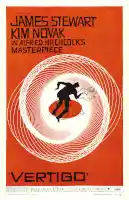
Receiver of the Look
I'm sure much has already been written and studied about
Vertigo and Kim Novak as Madeleine/Judy being "receiver of the look". Her body occupies an unusual placeholder space, first as stand-in for the real wife who will eventually be killed and thrown from the bell tower, then as stand-in for the illusionary 'Madeleine' that Scottie has loved and lost.
She isn't truly desired for herself as either character, and it's horrible to know that both Gavin and Scottie use her for the creation of this illusion. Once she has served their purposes in achieving their goals -- "Color, excitement, power. Freedom," for both men -- both throw her away.
Literally, in the end.
Scottie is intended to see her when he is not himself seen, to look at her when she isn't supposed to know she is being looked at, to follow her in ways that the pacing of the movie enforces as sinister. He devours her with his gaze, and steps into the trap that Gavin skillfully set for him: that seeing 'Madeleine' would transition into coveting her for himself. His inability to save her, coupled with the inner shame of an emotional affair transgressing his previous morality, effectively "disable" Scottie's investigator instincts for the better part of a year...
Until he sees a familiar face and body on the sidewalk, although the hair and makeup are different.
(Maybe it's a bit like spotting plotmapping.)
And because Scottie's occupied in looking at her so intently and in so many different voyeuristic circumstances, the audience necessarily is also.
In
Memento, Leonard's body is "receiver of the look".
He is physically touched, stripped (both by himself and by others), concealed, revealed, desired. He has a fight entirely in the nude, directly out of the shower; it's a trope we're not unfamiliar with, but usually the subject of that voyeuristic display is female-presenting.
Leonard has a voyeurism to himself also: he strips and the tattoos, gotten after his disabling and his wife's death, are a surprise every time. Because Leonard's occupied in looking at himself so intently... the audience necessarily is also.
His body is keeper of his history in a way somewhat more significant than a usual collection of scars and tattoos. His body is the silent witness that we witness in turn.
There's also something to be said about the way that our blondes "Madeleine" and Leonard both spend a lot of time being treated (by the characters of each film as well as the narrative of the film itself) as somewhat helpless and fragile creatures, totally under the sway of their respective mental illnesses (whether real or feigned), and ripe for manipulation or control by others who may not have their best interests at heart. It's only at the end that we the audience are shown without a doubt that they had power enough to effect their goals all along.
And in the end, we see Scottie and Teddy taking some of the same possessive, overly intimate behavior toward their blondes in a way that is somewhat romantic in Scottie's case -- and a horrible, dark-mirror version in Teddy's case.
318: "Hello, my love."319: Obey my order.321: I mean it: do what I say!"We are both survivors."
From Natalie's perspective, a stranger showed up at her work driving her boyfriend's car and wearing his clothes -- and acting like this was
entirely normal and reasonable! But having heard there was a guy out there matching his description (with memory issues, who will most importantly have no idea of where he's been or what he's done) she tests him, and figures out that he really does have the mental disability he professes to have.
Once her life's threatened, she uses his disability against him to bring him in line with her wishes, although it could be argued that this is nothing less than what Leonard owes her, having put her into the position of dealing with Dodd and the others when he played his part in Jimmy's death and the disappearance of all the money. When Leonard returns, confused about the violence he perpetrated on a stranger apparently on her behalf, she deals with the fallout.
During that interlude, her foremost trait of empathy (
she will help you out of pity, Leonard tells himself, using the people-reading skills that served him well as an insurance investigator) is fully exercised, and she takes the confused and hurting Leonard to bed with her. She listens to his fear and grief in the night, then in the morning helps him locate the man he's hunting.
Do Leonard and Natalie have sex? It doesn't actually matter: a higher intimacy has already been achieved. She has seen his mirrored tattoos in the same way that he has; she has read the sacred words from behind his shoulder for herself. She knows the empty place over his heart that only one thing will ever fill: vengeance completed.
The first time we meet her is the last time she sees Leonard: letting go of him, forgiving him for his unwilling role in her boyfriend Jimmy's disappearance... and reminding him they are both survivors.
In this cyclical ouroboros of a movie,
Natalie is the one who comes closest to a full protagonist's journey.
Whose Chance For A Second Chance Now?
So here's the question everyone's asked for the last twenty-five years: Was Leonard the one that killed his wife and not Sammy?
Look at how many words I've spewed on the digital page so far.
Memento takes
Vertigo and turns female into male, love into death (or vice versa), pinks and reds into blues, a dead socialite spouse into a dead drug dealer... and a manipulative liar into a disabled truth-teller.
Leonard's remembering correctly, because he learned it prior to the night his wife died: Sammy Jenkis's wife gave him his final exam, and he unintentionally killed her. The movie told you several times that most people probably wouldn't believe Leonard because of his disability.
They'd instead believe a lying, murdering, drug-dealing rapist of a crooked cop, with no evidence and every reason not to believe him, just because he said so.
And what does that say about
them, hmmm?
Time Is A Flat Circle (or, Wasn't This Where We Came In?)
There's something of a Doppler effect in the symbolism of the colors:
Vertigo with its warm tones is trying to move away from a moment it can't quite escape (the inevitability of a blonde falling to her death from a bell tower) and
Memento with its cool tones is chasing the moment that Leonard wants most (the moment where has killed his wife's attacker and avenged her death and his own permanent disabling).
Each has to do with the repeat or looping of time:
we always come back to this, the films both say. Every appearance of leaving is only the perceived differences of the return journey: the same details viewed from new angles as the same road is traveled in reverse.
Leonard can never heal
("How am I supposed to heal if I can't... feel time?") to move forward and have a happily ever after again with someone else. "Teddy" killed Leonard that night every bit as much as he and his partner killed Leonard's wife. Moving from vengeance achieved but unknown to vengeance known but not yet achieved over and over, he can never leave the closed loop of the movie that we see -- except for one brief instant that makes all the rest of it complete.
That is the end, in the movie that has no real end: he lays in bed with his wife in his arms once more, with the tattoos of his mute memory covering him, and the newest and last one which announces "I'VE DONE IT".
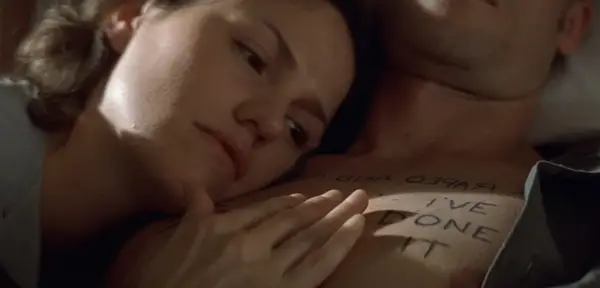
What more of heaven would any of us need, in Leonard's place?